
In the latest quarterly update, the Blockstream team turned months of research and roadmaps into products shipped. We proposed a post-quantum signature opcode for Bitcoin, introduced a brand new Jade to the lineup, published a Liquid Network roadmap that puts zero-confirmation (0-conf) and a trust-minimized bridge on the calendar, and shipped two Core Lightning releases.
Major Q2 Highlights
Q2 was a quarter of turning direction into delivery. Blockstream Research moved post-quantum Bitcoin from a working deployment on Liquid to an opcode proposal the wider Bitcoin community can evaluate. Jade has expanded into three models that each match a different kind of owner. A detailed Liquid roadmap set near-term dates for 0-conf transactions, new tokenization workflows, and a BitVM-style bridge. And across Lightning the team shipped twice, while celebrating the long career of the engineer who wrote more than half of Core Lightning.
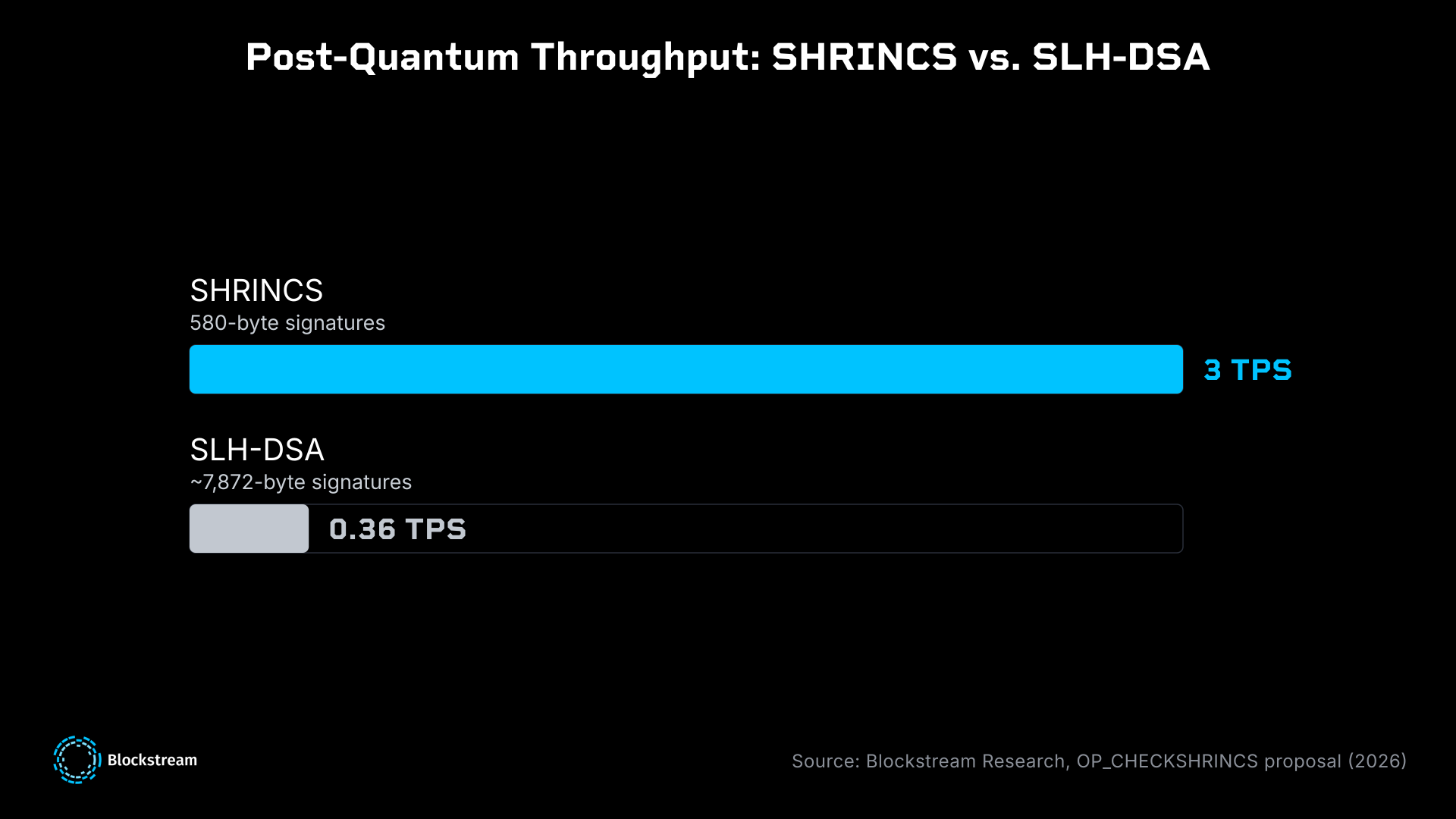
- A post-quantum signature opcode for Bitcoin. Blockstream Research proposed OP_CHECKSHRINCS, a hash-based scheme that reaches up to 3 transactions per second with 580-byte signatures, well ahead of the NIST-standardized alternatives.
- The Jade lineup, reimagined. Three concurrent models now cover every stage of self-custody: Jade Classic at $79, Jade Core at $99, and Jade Plus at $149.
- A Liquid Network roadmap with dates. 0-conf, removal of the issuance limit, a BitVM-style bridge, updates to the AMP tokenization platform, and much more. The team also released new official Liquid Network documentation for easier integration with LWK, thanks to feedback from Liquid Federation members.
- Blockstream Enterprise, in the field. we took our full institutional stack to banks and allocators across Q2, and is preparing a limited beta for a select group of enterprise customers.
- Two Core Lightning releases. Version 26.04 graduated splicing out of experimental status, and 26.06 made xpay the default handler for payments.
- Analytics and rate limiting for the Explorer API. Release 26.03 added per-API-key usage history and production-grade rate limits.
Blockstream Research: Post-Quantum Throughput on Bitcoin
In March, Blockstream Research broadcast the first post-quantum-signed transactions on the Liquid Network. In Q2, that work turned outward, from a deployment running on a production sidechain.
In May, Director of Research Jonas Nick published the design of OP_CHECKSHRINCS, a proposed Bitcoin opcode built on SHRINCS, a stateful hash-based signature scheme. The argument is throughput. The compact configuration reaches up to 3 transactions per second with 580-byte signatures, against roughly 0.36 transactions per second for the NIST-standardized SLH-DSA. SHRINCS leans only on the security of SHA-256, the same hash function Bitcoin already uses for proof-of-work, address derivation, and Merkle trees, so it adds no new cryptographic assumption to the system. It shipped with a C++ implementation, a Simplicity verifier, and a specification draft the community can read and test.
Two explainers ran alongside the proposal, one breaking down the quantum threat in plain language, including why a meaningful share of circulating bitcoin already sits behind exposed public keys, and one explaining lattice-based signatures as "Schnorr, but with vectors." Together they map the trade-offs Bitcoin faces: hash-based schemes like SHRINCS are conservative and deployable now, while lattice-based designs carry algebraic flexibility that could one day support multisignatures.
On the Simplicity side, we hosted a Simplicity hackathon at Blox Space in Turin on May 16th and 17th. Around 25 developers, over $3,000 in bitcoin as the grand prize, and a panel of judges that included our own Andrew Poelstra and Seth Schoen produced six finished projects in two days. Simplicity is here and ready for builders!
Blockstream Consumer: Hardware and Software Advancements
Most people who own bitcoin say they believe in self-custody. Far fewer actually practice it. Roughly 85% of holders say keys should be theirs, while only about 30% hold their own. We addressed this problem head on with April’s introduction of Jade Core, the easiest offramp from exchanges on the market.
Introducing Jade Core.
— Blockstream (@Blockstream) April 28, 2026
Your first step to Bitcoin self-custody. pic.twitter.com/baDA7G2RlU
The lineup now spans three concurrent models, all sharing the same open-source firmware and blind oracle security model.
Jade Classic at $79 is the original open-source device, still in production, with USB-C, Bluetooth, a color display, and a built-in camera.
- The all new Jade Core at $99 is the off-ramp device: a simple, five-minute path off an exchange for a first-time owner, with free worldwide shipping.
- Jade Plus at $149 is the advanced device, built for maximum control with air-gapped QR signing, SD card support, and an aluminum body. It’s now available in three slick metal finishes: Sovereign Green, Rose Gold, and Stealth Black.
Jade also became more useful as an everyday security device. In May, firmware 1.0.40 added full two-factor authentication backup. Jade can now import any standard one-time password (OTP) setup by scanning a QR code, including a migration straight from Google Authenticator, store those codes on the device, and export them as a QR code or secret key. The codes are generated in hardware, offline, and stay behind the device PIN. These OTP records live on the device itself rather than in the wallet seed, so restoring a Jade from the recovery phrase brings back the bitcoin but not the authenticator records.
On the software side, the Blockstream app team is working to reintroduce Lightning functionality through a fully vertically integrated Blockstream stack, including Blockstream-coordinated liquidity services. Expect more announcements about an open beta soon.
If you haven’t already, download the Blockstream app now for the all-in-one Bitcoin experience.
Liquid Network: Development Roadmap Released
In May, we published a detailed Liquid Network development roadmap that put concrete work on a calendar across payments, tokenization and quantum readiness.
As the @Liquid_BTC network’s tech provider, Blockstream is sharing an updated roadmap for the core development workstreams it leads.
— Blockstream (@Blockstream) May 6, 2026
0-conf, quantum readiness, BitVM exploration, institutional custody, P2P lending, and much more are in development.https://t.co/WrrThPxuZW pic.twitter.com/eetzhy9SFE
For payments, the next major feature release is 0-conf transactions, which bring near-instant, safe-to-act-on transfers to Liquid. Liquid Federation members Boltz and SmartPay have been close partners and are actively using the public beta and providing feedback. The team is targeting a full release in early July.Since the roadmap announcement, we have also successfully activated ELIP 203, which removed the 21-million issuance limit. This allows issuers to mint fiat instruments and large securities without an artificial cap. A companion proposal still under consideration, calledmulti-asset fees (MAF), would additionally let users pay transaction fees in issued assets, such as USDT, rather than only LBTC, cutting friction in markets where users don't keep a balance of the native asset.
For institutions, AMP2 rebuilds the asset-management platform so issuers no longer need to run node infrastructure or use additional scripts. AMP2 has a public release targeted for Q3, with AMP0 to AMP2 migrations running through the second half of the year.Bridge economics received attention too: a user pays for peg-in (UPP) option and Taproot-based peg-in sweeps that cut costs from roughly 500 sats to 20-30. Further out, the roadmap includes a BitVM-style 1-of-n bridge that lowers the trust assumptions of today's threshold-signature model, alongside a staged quantum-readiness plan that carries the research from the OP_CHECKSHRINCS work onto Liquid.
For developers, the roadmap leans on two pieces of maturing infrastructure:
- The Liquid Wallet Kit (LWK) consolidating into the go-to toolkit for Liquid use cases, such as asset issuance, Lightning support, as well as hardware and software wallet support.
- The Simplicity smart contracting platform, which is expected to have a slew of new infrastructure development, including release prototypes for bitcoin-backed lending, a decentralized exchange (DEX), and a price attestation oracle.
Liquid infrastructure is already carrying real value: more than $5 billion in tokenized real-world assets have been issued, and the Blockstream app now displays live fiat prices for Liquid assets, starting with USDT and a tokenized U.S. Treasury bill and expanding to other tokenized securities.
Blockstream Enterprise: In the Field, Ahead of Beta
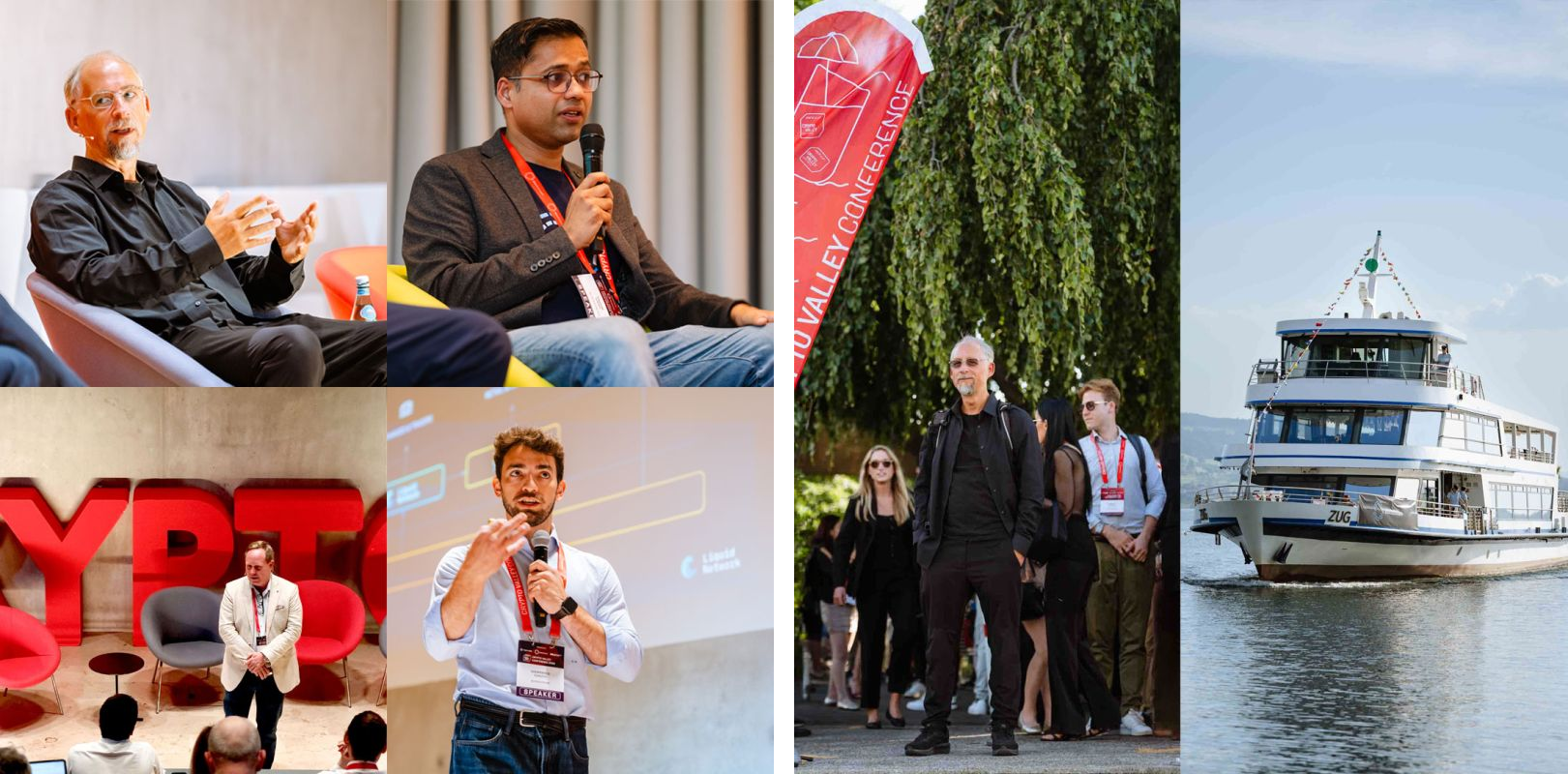
Blockstream Enterprise stayed on the road in Q2. At the institutional venues where banks and allocators are deciding how they hold bitcoin, we presented our full stack, custody, tokenization, settlement, and formally verifiable smart contracts, on main stages and in hands-on workshops. A dedicated group fronts those conversations, led by Sagun Garg, Director of Enterprise Products and Solutions, and Phil Barkett, VP of Enterprise Products, with product manager Gianmarco Guazzo running workshops on deploying institutional smart contracts without the usual execution risk.
The clearest pull is in European banking, run from Blockstream’s Lugano headquarters. As presenting partner of the Crypto Valley Conference in Zug, the enterprise team held two days of institutional meetings and hosted a builders-and-institutions cruise on Lake Zug. That interest is turning into joint work: in early July, we sit down with the banking teams at Swisscom and Luzerner Kantonalbank to write formally verifiable lending contracts on Liquid together.
Behind that field work is product development. Blockstream Enterprise is preparing a limited beta access for a select group of enterprise customers, with configurable workspace security policies and both application and SDK interfaces. Institutions that want a closer look can request access ahead of the beta.
Explorer API: Analytics and Rate Limiting
Developers building on the Blockstream Explorer API got better visibility into their own usage in Q2. Release 26.03 added per-API-key usage history with visual charts across both Bitcoin mainnet and Liquid, time-range selection, and a billing-period summary, so a team can see exactly what it's consuming and forecast what it will need. The same release introduced production-grade rate limiting on paid tiers, with unlimited calls reserved for Enterprise, plus customizable access-token expiration from 5 to 300 minutes. The result is an API that's easier to budget for and more dependable under load, whether a developer is on the free tier or running production infrastructure.
Core Lightning: Two Releases and a Farewell
Core Lightning shipped twice in Q2. In April, version 26.04, "Negative Routing Fees," graduated splicing out of experimental status, so node operators can resize channels without closing and reopening them. The release landed 421 commits from 23 authors over 110 days, added a faster parallel path-finding engine, expanded the bookkeeper accounting plugin, and trimmed binary size by roughly 20%.
Cln-application release v26.04 focused on making channel management, accounting, and troubleshooting more practical for node operators. The release added the ability to force-close a channel when a peer remains disconnected for 10 seconds, improved channel-state pending details in tooltips, and introduced custom fee-rate controls for channel openings and withdrawals. Bookkeeper gained a filtering dropdown for the balance sheet and sats-flow screens.
In June, CLN version 26.06, "Quantum-Resistant Lightning Channel," introduced bwatch, an experimental block-watching plugin, made xpay the default handler for payments, and added a new createproof command to generate a cryptographic payment proof for a completed BOLT12 offer payment, allowing the sender to verifiably demonstrate that the payment was successfully fulfilled to the recipient. It also widened the channel-closure dispute window from 12 to 72 blocks, giving node operators more room to respond to a disputed close. The release carried 236 commits from 19 authors in 42 days.
Our Lightning leaders represented Core Lightning at the Vienna protocol summit, taking part in the discussions shaping Lightning’s next chapter. Privacy and resilience, messaging and payments were high on the agenda.
Lightning’s BOLT specifications remain in-progress documents, with changes advanced through public proposals, pull requests, review, and eventual implementation work. The Vienna discussions identify priorities and possible next steps; a topic only becomes a network-wide standard once it progresses through that open specification process
In more bittersweet news, we published a retrospective on Rusty Russell in June, who is leaving after eleven years. Rusty wrote the first Lightning implementation, chaired the BOLT specification process, created the lnprototest compliance suite, and championed BOLT 12 Offers from 2020 until it shipped. The numbers tell their own story: 9,762 commits to Core Lightning, about 54% of every commit in the project, with only 18 reverts across nearly ten thousand changes.
On May 26, 2015, @rusty_twit made his first commit to Core Lightning. What happened over the next eleven years speaks for itself.
— Core Lightning ⚡️ (@Core_LN) June 9, 2026
Thank you, Rusty. ⚡https://t.co/uTTs0tDiCp
For Rusty, Vienna marked the last of many such summits—a fitting final gathering after more than a decade helping build, specify, and advance the Lightning protocol.
His first commit, on May 26, 2015, was a "silly cmdline util to create an openchannel packet." Everything Lightning became at Blockstream traces back through that work, and we wish Rusty well in all his future endeavors.
Media & Event Highlights

- CNBC's Squawk Box and Bloomberg, denying the Satoshi report and confirming he is not Bitcoin's creator, with an April 9 video, an April 10 podcast giving three technical reasons against the theory, and a May 2 feature on being at peace with Wall Street's Bitcoin era.
- Forbes, on the $80 billion risk premium the Satoshi speculation created, and the Endgame with Amanda Cassatt podcast, on Bitcoin's origins and the Satoshi mystery.
- Keynotes at Paris Blockchain Week, on Bitcoin's evolution beyond a store of value, and at BTC Prague 2026.
- Bitcoin Magazine at Bitcoin 2026 in Las Vegas, with Strategy's Phong Le, on building Bitcoin's technical and financial infrastructure.
- BitGo's From the Vault with Mike Belshe and Bitcoin Suisse, on quantum readiness and why Bitcoin's migration clock is already ticking.
- Crypto Valley Conference in Zug, a fireside with Luzerner Kantonalbank's Serge Kaulitz.
- Consensus 2026 Miami, on Bitcoin's security advantage over DeFi.
- FOX Business's The Claman Countdown, on Bitcoin as a discovery rather than an invention.
- Proof of Talk at the Louvre, with Franklin Templeton CEO Jenny Johnson, broadcast on Bloomberg.
- The Bitcoin Rails podcast with BIP 360 co-author Ethan Heilman, on post-quantum signature schemes and Blockstream Research's hash-based signature work.
- The main stage at OPNEXT 2026 in New York presenting OP_CHECKSHRINCS, and a Bitcoin 2026 Las Vegas panel on post-quantum signatures with Tadge Dryja and conduition, moderated by Brink's Mike Schmidt.
- A Bitcoin 2026 Las Vegas talk on Verifiable Smart Contracts with Simplicity.
- Digital Assets Week New York, a panel on "TradFi and digital asset custody convergence" with Citi Strategic Ventures' Mira Witzig Borja.
- Crypto Valley Conference in Zug, leading "The Last Mile – Bridging On-Chain to Bank Infrastructure" with SWIFT's Nick Kerigan.
- Istanbul Blockchain Week, the "Beyond the Dollar: The Emerging-Market Stablecoin Playbook" panel with Tether's Marco Dal Lago.
- TheStreet Roundtable, on Bitcoin as the infrastructure layer for finance and Liquid's track record.
- BeInCrypto at the Web3 Banking Symposium in Zurich, on Bitcoin's long-term vision and accelerating adoption.
- Citi Institute's Tokenization 2030 report, which featured his interview on tokenization on the Liquid Network.
Looking Ahead: Q3 Priorities
- Consumer: Expand the Blockstream app capabilities with AMP2 support and the highly anticipated return of native Lightning experience. Stay tuned!
- Liquid: Two Elements releases are planned for Q3: 23.4.0 and 23.5.0, which will support UPP (ELIP 202), 0-conf, and enforce several older network policies (Dust-CT and Discount-CT) by default to improve the overall node-running experience.
- Enterprise: Add ETF coverage for the Cryptocurrency Data Feed, refresh the GUI for Explorer API with more granular features, and the custody solution and AMP2 tokenization platform both move into beta with existing partners.
- Research: Quantum-ready Confidential Assets, a draft SHRINCS Bitcoin Improvement Proposal, and completing the ChillDKG BIP, alongside ongoing contributions to libsecp256k1 and maintenance of libsecp256k1-zkp.
- Lightning: Planning for a Core Lightning v26.09 release, upgrading Greenlight to Core Lightning v26.06. We will also continue improving Lightning functionality in the Blockstream app, which is powered by Greenlight technology.
For more information, visit blockstream.com, reach out to press@blockstream.com, or DM @Blockstream on X.