
Over the last several years, Liquid has become an increasingly important part of how bitcoin is used every day, powering payments, asset issuance and programmable financial applications, often behind the scenes.
As the network’s technical provider, we are sharing an updated roadmap across the core development workstreams Blockstream believes will define Liquid’s next phase of growth.
Growth and Adoption: Liquid’s Expanding Role in Payments and Capital Markets
Growth across the network is accelerating. We have seen transaction activity climb sharply, TVL expand significantly, Federation membership broaden, and the range of assets and applications on Liquid become more diverse. Underpinning that momentum is the same strong track record, uptime and security-first development philosophy that continue to differentiate Liquid.
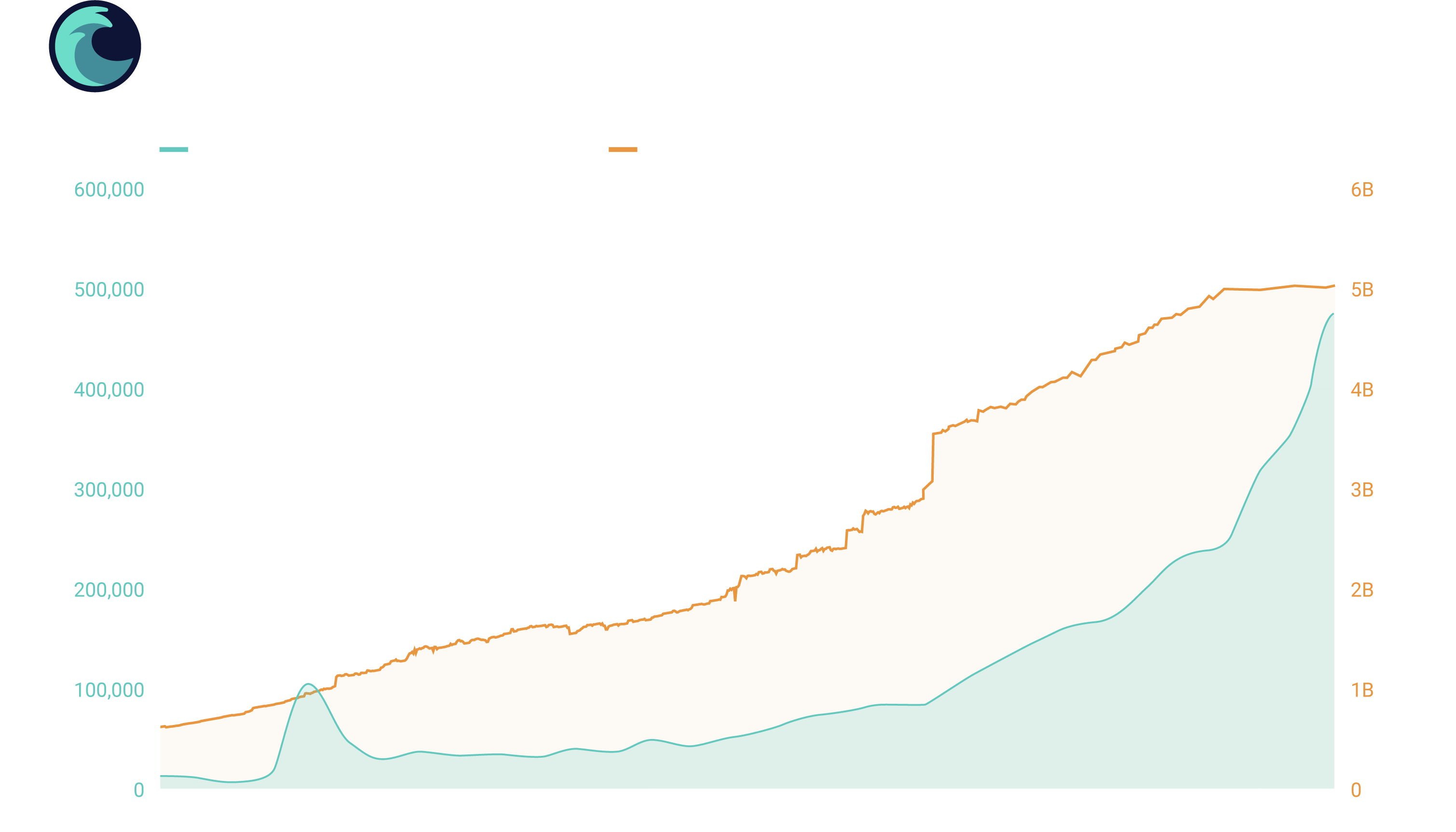
We are also seeing this growth come from multiple directions at once.
On the payments side, Lightning interoperability and swap capabilities from providers such as Boltz and Breez, along with wallet integrations like AQUA, the Blockstream App and Bull Bitcoin, have made Liquid increasingly useful for settlement. This has been complemented by new Liquid-native stablecoin activity. BRL-denominated stablecoins such as DePix, for example, are helping drive remittance and merchant payment flows in emerging markets and bringing Liquid more directly into everyday commerce.
Capital markets adoption has also deepened. Liquid now supports more than $5 billion in tokenized real-world assets, more than $250 million in value on Bitfinex Securities, over $1.5 billion in tokenized asset volume through STOKR, and billions in tokenized private credit through Mifiel. That activity spans a growing mix of asset classes, including private credit, fixed-income-style instruments, tokenized funds, precious metals exposure, and other digitally native capital-markets products.
These trends show that Liquid is no longer defined by a single use case or narrative and is emerging as native Bitcoin financial infrastructure.
Elements Codebase: Better UX for Payments and Tokenization
At the foundation of Liquid’s tech stack is Elements, the open-source blockchain platform Blockstream maintains as a Bitcoin Core-derived codebase. It extends Bitcoin’s battle-tested architecture with features such as confidential transactions, asset issuance, deterministic block signing, and smart contract programmability.
Liquid is the leading production deployment of Elements, with new capabilities typically developed there first and then considered for activation on the network through Federation governance and Technology Board review.
Against that backdrop, the first major roadmap track is focused on making tokenization and payments materially easier to use.
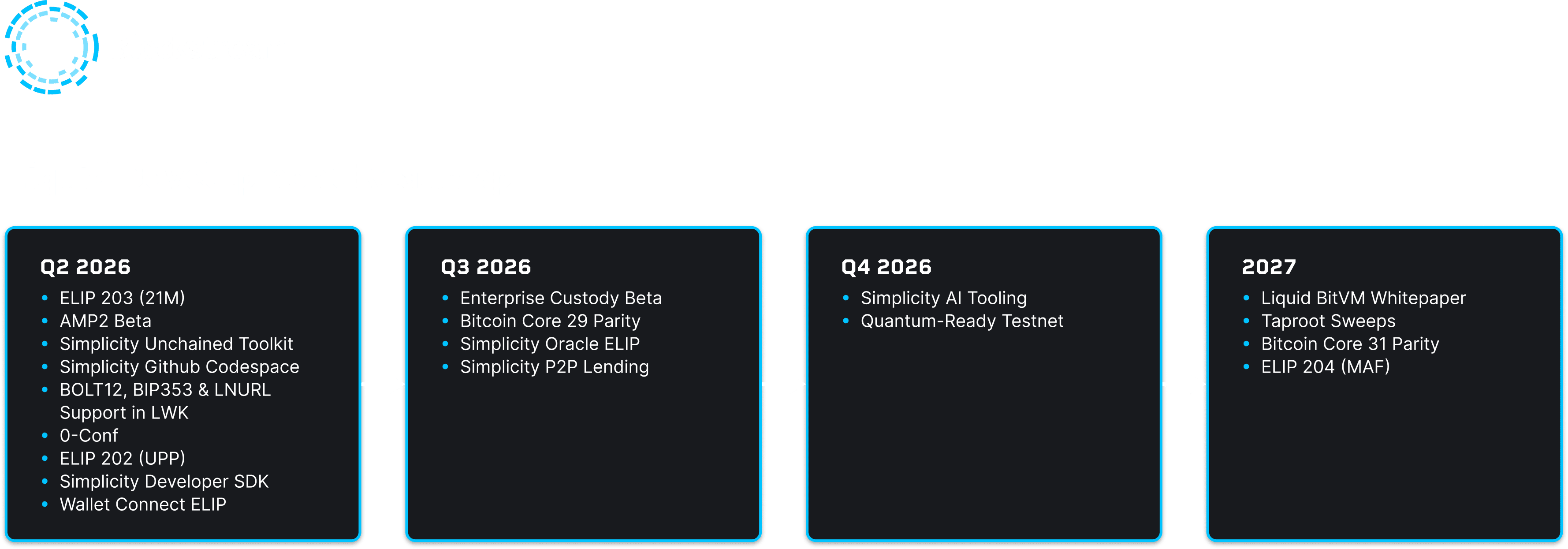
21M issuance limit removal: One of the most important changes coming is ELIP 203, which allows the issuance and reissuance of assets above the limit of 21 million - a ceiling inherited from Bitcoin’s fixed monetary supply. For fiat-denominated instruments, large-scale securities, or high-unit-count commercial assets, the restriction is an unnecessary constraint. ELIP 203 removes that restriction for non-LBTC assets to improve UX by letting issuers work with explicit supplies that reflect the realities of the assets they are representing.
As a consensus-affecting change, ELIP 203 requires a coordinated hard-fork. Blockstream is coordinating that process with the Federation and is currently targeting a late May 2026 activation window, broadly in line with the roughly six-month upgrade cadence used for the last hard-fork, which activated Dynamic Federations (DynaFed).
0-conf: Another UX upgrade is 0-conf, aimed at enabling near-instant settlement for Liquid transactions. This allows services to safely act on transactions before block confirmation in cases where policy and network conditions make that reasonable. On Liquid, this is particularly compelling because blocks are deterministic and one minute apart, and because the network is increasingly being used for swaps and payment experiences where waiting even a single block can feel like friction. Our current roadmap work includes beta testing with Federation members, including flows relevant to providers such as Boltz, and now also includes a websocket-based version for broader testing.
A public beta is planned in the coming weeks, with future work exploring Esplora integrations and ways to publish this data for other block explorers and third parties to consume and expose. We are targeting a June 2026 release for these changes.
MAF (multi-asset fees): ELIP 204 proposes another UX improvement by enabling users to pay transaction fees in issued assets, other than LBTC. Under MAF, nodes would be able to accept selected assets for mempool relay and block inclusion at configured exchange-rate multipliers relative to the pegged asset. Accepted fee assets and rates could be set locally or updated through an authenticated on-chain controller transaction, and block creators could publish the accepted fee assets and corresponding multipliers in coinbase outputs so wallets can discover the current policy.
In emerging markets, users may hold stablecoins, so requiring a separate balance of LBTC purely for fees adds friction. For institutions, the same issue appears as treasury and accounting complexity: if the operating balance is meant to stay dollar-denominated, needing LBTC for fee management adds extra exposure and overhead.
MAF is currently under review by the Federation’s Technology Board for activation on Liquid. We welcome comments on ELIP 204 and other Elements Improvement Proposals to better inform on-going discussions.
Elements Codebase: Strengthening the Foundation
In parallel, we will continue investing in the essential (not always glamorous) work of maintaining and upgrading Liquid’s core infrastructure.
That security-first philosophy runs through the entire roadmap. Liquid is meant to expand what can be built on Bitcoin without compromising the rigor, resilience and technical discipline that institutions expect.
That is why so much of the Elements roadmap is focused on the underlying codebase itself, cryptographic maintenance, and bridge sustainability, not just user-facing features.
Bitcoin Core parity: The ongoing work to maintain parity with Bitcoin Core, allows Liquid to inherit upstream fixes, performance improvements, and developer familiarity. The team has already reached Bitcoin Core 29 parity and is now focused on preparing a stable release, with the goal of a release candidate by July 2026. As with other major upgrades, final release timing remains subject to review and approval by the Technology Board and Federation as needed.
This work also includes the latest libsecp256k1-zkp QoL and cryptographic updates mentioned here. That library underpins Elements, the Liquid instance, and related tooling, and was recently brought back in line with roughly 2.5 years of upstream libsecp256k1 improvements. Elements 29 is expected to include those updates as part of this broader parity effort.
UPP (user-pays peg-in): ELIP 202 addresses the long-run sustainability of the peg. Every peg-in creates a new output on Bitcoin that Liquid’s 15 functionary operator set eventually has to manage, consolidate or renew. Those costs can become non-trivial, especially for small peg-ins. UPP proposes an optional subsidy policy for peg-ins, plus an optional minimum peg-in amount. These small peg-in claims would include an OP_RETURN subsidy output that burns an amount proportional to the expected cost of later spending the corresponding mainchain UTXO. In other words, the user who creates the future operational burden helps pay for it up front.
This makes the network more sustainable in two ways. First, it aligns peg-in economics with actual operating cost instead of distributing that cost indefinitely across the Federation. Second, it nudges very small flows toward alternatives (such as swaps) when those are operationally more efficient.
UPP has already been merged and is now publicly available in Elements 23.4.0rc2, allowing Liquid apps to begin integrating it and experimenting with the feature ahead of activation. The next step is to work with the Technology Board to finalize an activation date and process for enabling it more broadly on Liquid.
Taproot sweeps: Running alongside UPP is our work on Taproot sweeps, aimed at improving the economics of managing peg-in UTXOs on Bitcoin. Because Liquid’s bridge outputs must be actively maintained over time, sweep efficiency matters. Under the current SegWit model, later sweeps can cost ~500 sats per UTXO; by sweeping into Taproot outputs instead, that cost can fall to around 20-30 sats. That is a meaningful improvement for network sustainability and helps make ongoing bridge operations more economically feasible as usage grows.
This work has been an active focus over the past year, preparing the watchmen and surrounding infrastructure for more efficient signing sessions and sweep behavior. Like UPP, it is not a flashy end-user feature, but it is important to Liquid’s long-term resilience. We are currently targeting network activation in 2027.
Quantum Readiness: Proving the Path to Quantum-Safe Blockchain Infrastructure
For a primer on where the risk sits, see is Bitcoin quantum resistant?
Post-quantum readiness is another major focus for us, and recent developments have made clear that the conversation is now entering a more serious phase. Last month, Google Quantum AI published new research and guidance encouraging the industry to begin preparing now for a transition to post-quantum cryptography.
We believe Liquid is uniquely positioned to lead that transition. Through the Simplicity smart contract language and the broader Bitcoin-like technology stack, Liquid gives us a production environment where post-quantum protections can be designed and proven under real-world conditions. Blockstream Research’s recent demonstration of post-quantum signature verification on Liquid was an important step in that direction.
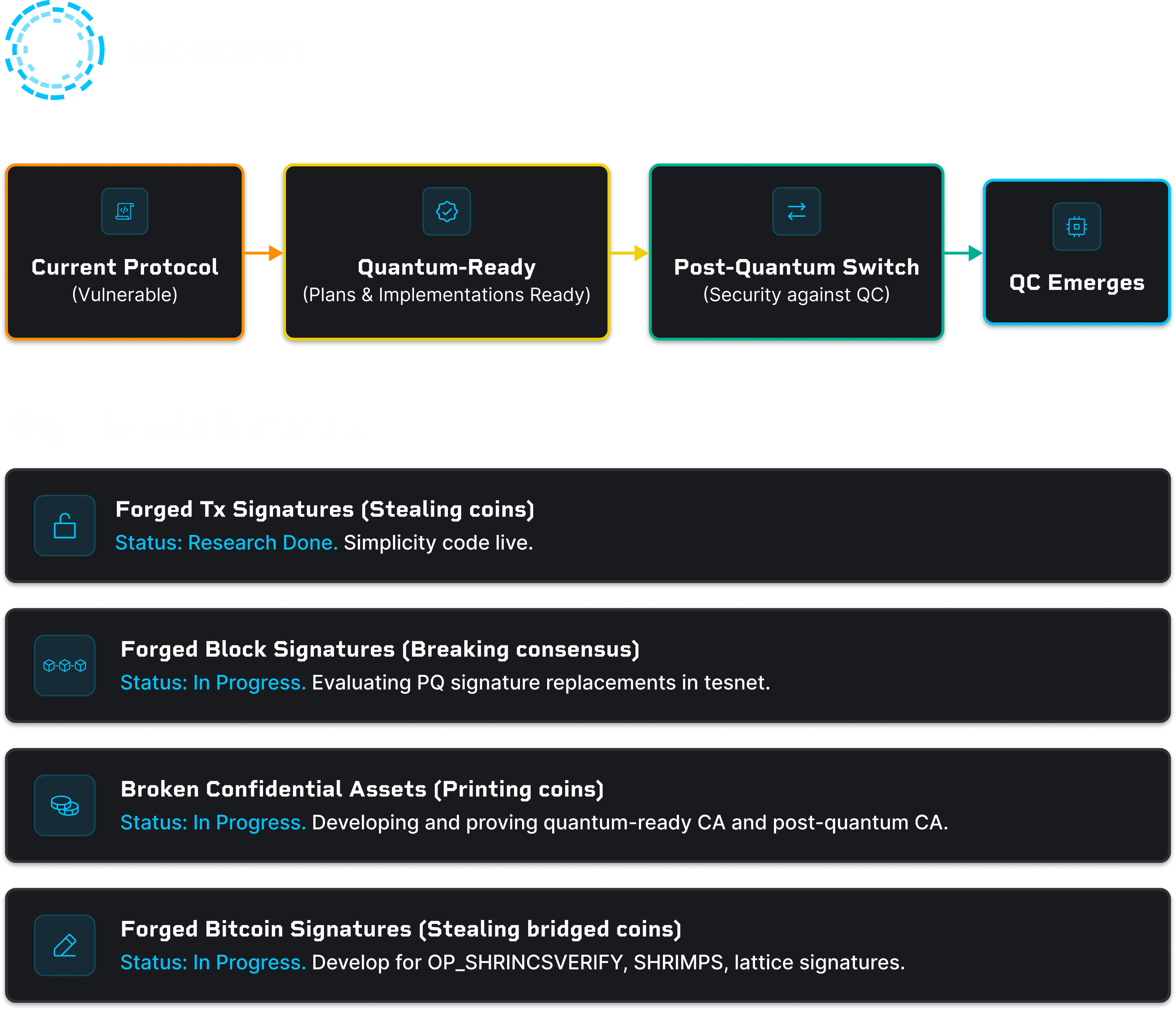
We see the path to full quantum readiness as a four-step progression. First is the current protocol, where classical cryptography remains vulnerable to a sufficiently capable quantum computer. Second is becoming quantum-ready, meaning the mitigation plans and user-facing implementations are in place before the threat arrives. This is where we are beginning to make real progress today. Third is the post-quantum switch, where those protections are activated to secure the network against a quantum-capable adversary. The fourth stage is the point at which a cryptographically relevant quantum computer finally emerges; by then, the goal is for the necessary protections to already be live.
To achieve these goals, we are focusing on the essential building blocks of a quantum-ready network. Our immediate research priorities include developing Switch Commitments to protect the integrity of Confidential Assets against quantum adversaries. This work centers on providing provable security through rigorous formal proofs, while offering a wallet-side upgrade path that does not require immediate consensus changes. We are also standing up an experimental environment to evaluate post-quantum block signatures and demonstrate the infrastructure required for a quantum-ready state.
Because Liquid’s bridge security ultimately depends on the Bitcoin mainchain, we are also actively contributing to post-quantum research for Bitcoin itself. This includes formalizing new hash-based signature schemes into a Bitcoin Improvement Proposal (BIP) and advancing research into lattice-based cryptography.
We believe these efforts will move the industry toward concrete security upgrades, and we welcome collaboration from researchers and teams who want to help shape a credible path to quantum-safe Bitcoin infrastructure.
Research Initiative: Reimagining the Peg with BitVM
Beyond the current roadmap, we are exploring a longer-term research initiative: a BitVM-style 1-of-n bridge for Liquid.
BitVM has introduced a path toward bridge designs with meaningfully lower trust assumptions than traditional threshold-signature models, making it an important area of study for Bitcoin-based financial infrastructure.
For Liquid, we see this as an active research track and are evaluating the potential for a BitVM-style bridge to further minimize the network's trust assumptions. Our work focuses on two primary areas: optimizing the cryptographic circuits required for efficient bridge security, and leveraging advanced proving systems to validate Liquid’s consensus rules. Our goal is to evaluate these architectural trade-offs, define a safe migration path from the current bridge architecture, and finalize a design that will serve as the blueprint for our production implementation.
LWK: Unified Integration for Liquid Applications
As Liquid supports a broader range of applications, asset workflows, and smart contract use cases, the need for a more unified developer experience becomes increasingly apparent. That is the role the Liquid Wallet Kit (LWK) is meant to play.
LWK is the core means for building on Liquid, giving developers a common integration toolkit instead of forcing them to handle each low-level component themselves. It already supports much of the stack, including confidential transactions, asset issuance and management, Simplicity, and signing across both software and hardware wallets.
Over the next six months, our focus is to strengthen that foundation by improving documentation, making running high-volume wallets easier, extending Lightning Network support (via Boltz) with BOLT12 offers, BIP353 DNS payment instructions, LNURL and more. We also plan to add more hardware signer support, and expand LWK so AMP2 and Simplicity can be used more reliably in production, including in web environments.
Simplicity: High-Assurance Smart Contracts
Simplicity is another key part of Liquid’s long-term growth. It is designed to bring more expressive smart contracts to Bitcoin without sacrificing predictability, auditability or security. Unlike earlier smart contract environments, Simplicity is resource-bounded, deterministic and built for high-assurance financial applications.
That is why we see it as such an important part of Liquid’s future. Our goal is to enable programmable finance without repeating the fragile assumptions and security tradeoffs seen elsewhere.
We are now focused on turning Simplicity from a research breakthrough into a production-ready development environment. Key pieces are already taking shape: the Simplex SDK has been released, LWK is becoming the primary interface for building Simplicity contracts, Jade signing support is working, and early applications such as a prototype lending contract, a DEX, and a post-quantum verifier are already being built.
There is also still work ahead to make Simplicity practical for developers and users. Over the coming months, we will develop stronger developer tooling, price-attestation oracle infrastructure, more contract examples, and production-grade applications that can bring real liquidity and economic activity to Liquid.
Blockstream Enterprise: Institutional Custody and Tokenization
The final major area of development is the expansion of Blockstream Enterprise. This suite serves as the essential gateway for banks, exchanges and financial institutions seeking to add Liquid’s unique advantages with the highest standards of institutional security.
The suite is built upon two foundational pillars: custody and tokenization.
The enterprise custody solution uses a multi-key setup architecture that supports customized security configurations. To integrate seamlessly into existing operational workflows, the solution will be available both as a user-friendly application for operations teams and as a robust SDK for automated environments. It also includes a fully configurable workspace, allowing institutions to define their own governance model through granular controls for users, groups, automated workflows and transaction request processes. We are targeting a public beta release for July 2026.
To learn more or request early access to Blockstream's enterprise custody solution, interested parties can fill out the form here.
Complementing this is our tokenization module, Blockstream AMP (Asset Management Platform). AMP is not a native feature of Liquid, but a policy and compliance engine built on top for issuers that need issuance workflows, transfer controls and operational policy enforcement. Liquid provides the settlement rail, privacy model, asset system and scripting environment. AMP adds the issuer programmability needed to manage digital assets at scale.
Much of our focus is now on the transition from AMP0 to AMP2. The new version of AMP is designed to reduce much of the friction in the earlier model with a simpler, more integration-friendly architecture. Operations no longer require node infrastructure or additional scripts, and the system consolidates transaction construction, policy enforcement, investor onboarding and HSM-backed cosigning into a unified flow.
We see AMP2 as a major step forward for tokenization workflow: easier to integrate, easier to operate, and better suited for regulated, high-assurance asset issuance at scale. Blockstream is targeting a public AMP2 release by the end of May 2026, followed by migration work through the second half of the year.
Liquid: Building Bitcoin’s Financial Layer
These active development streams all point in the same direction: strengthening Liquid as Bitcoin’s financial layer.
None of these efforts are an island. Each one reinforces the others. Improvements to Elements make Liquid easier to use and more resilient. LWK helps developers bring those capabilities into production. Simplicity expands what can be built on the network. AMP makes tokenization easier to deploy and manage. And longer-term work on post-quantum security and BitVM helps ensure the network continues to strengthen at the cryptographic and protocol level into the future.
Liquid’s future is strong, and we want more developers, researchers and builders across the ecosystem involved in shaping it. For those who want to contribute, the open-source repositories for Elements, LWK and Simplicity are where much of that work will continue to take shape.