
In the latest update, Blockstream delivered a landmark quarter. We executed the first post-quantum signed transactions on the Bitcoin-based Liquid Network, enabled the first hardware wallet–secured Lightning payments, launched real-time blockchain data infrastructure for developers, and expanded its institutional presence across seven countries. Together, these milestones further define Blockstream’s role in supporting Bitcoin’s evolution across consumer, enterprise, and developer ecosystems.
Major Q1 Highlights
Q1 was a quarter of firsts. Blockstream Research broadcast the first post-quantum-signed transactions on a production sidechain. Jade became the first hardware wallet to send and receive Lightning payments through cold storage. A sustained institutional calendar spanning seven countries, a new real-time developer API, and strategic hardware partnerships rounded out three months defined by the kind of product breakthroughs that only a full-stack Bitcoin infrastructure company can deliver.
- Post-quantum milestone: Blockstream Research deployed SHRINCS post-quantum signature verification using Simplicity, broadcasting the first post-quantum-signed transactions on Liquid.
- Jade Lightning payments: The Blockstream app 5.2.0 pairs with Jade to deliver the first cold-storage-secured Lightning payments experience in any Bitcoin wallet.
- Desktop app: Blockstream desktop app 3.0.0 and 3.1.0: A ground-up redesign with built-in bitcoin purchasing, followed by Lightning ↔ Liquid swaps arriving on desktop.
- Jade Plus Colors: Along with new partnerships, we revealed three new colors for Jade Plus in its sleek metal finish.
- Global institutional presence: Blockstream presented across El Salvador, Dubai, Zurich, the Cayman Islands, Hong Kong, Italy, and Miami to advance institutional and developer adoption.
- Explorer API Electrum RPC: Real-time address monitoring via persistent connections, batch requests, and compatibility with the Waterfalls protocol.
- Lightning: Core Lightning 25.12.1 and cln-application v26.01: Critical fixes for new nodes and a refreshed application layer with faster load times, improved UX, and stronger system resilience.
Blockstream Research — Post-Quantum Security and Beyond
The quantum conversation has been loud since the turn of the new year. While debates roar surrounding Bitcoin’s efficacy in a post-quantum world, our research team has been making major advances in post-quantum cryptography, cross-input signature aggregation, and Simplicity tooling across research and development.
Post-Quantum Signature Deployment on Liquid
Blockstream Research achieved a major milestone in Q1 2026: deploying post-quantum signature verification on the Liquid Network using Simplicity smart contracts and broadcasting the first transactions on a production Bitcoin sidechain signed with a post-quantum signature scheme, securing real value on Liquid mainnet.
Users can now protect their Liquid Bitcoin and issued assets against future quantum computer attacks.@blksresearch has deployed post-quantum signature verification on the @Liquid_BTC Network using Simplicity - a first on a production Bitcoin sidechain.
— Blockstream (@Blockstream) March 3, 2026
Opt-in quantum… pic.twitter.com/6bF80fgWBq
The deployment uses SHRINCS, a compact hash-based post-quantum signature scheme developed by Blockstream Research specifically for blockchain environments. SHRINCS offers two modes: a stateful mode producing compact signatures for normal operation, and a stateless fallback ensuring fund recovery if state is lost. The scheme relies solely on hash function assumptions already underpinning Bitcoin's design.
Rather than requiring a consensus change, the team built a complete post-quantum signature verifier using Simplicity's custom spending conditions. You can voluntarily lock assets, including Liquid bitcoin (LBTC), stablecoins, and tokenized securities, to contracts requiring post-quantum signatures. Two production transactions demonstrated the system: one using a stateful signature and one using the stateless fallback. In a nod to the cypherpunk roots of the work, extra transaction space was filled with the Bitcoin whitepaper.
This builds on earlier Q1 momentum, where Blockstream cryptography engineer Mikhail Kudinov and Director of Research Jonas Nick posted to the Bitcoin-Dev mailing list about evaluating hash-based signatures as a post-quantum alternative to ECDSA and Schnorr.
The verifier is open-source and available on GitHub. The signing code is also available, and technical discussion continues on Delving Bitcoin.
The deployment received coverage across BTC Times, MEXC News, and other outlets.
DahLIAS Accepted to Eurocrypt 2026
In March, Blockstream Research announced that the DahLIAS paper has been accepted to Eurocrypt 2026 in Rome. DahLIAS enables cross-input signature aggregation (CISA) on Bitcoin's secp256k1 curve, a technique that could meaningfully reduce transaction sizes and fees on the Bitcoin network. The paper was co-authored by Yannick Seurin (Ledger), Tim Ruffing, and Jonas Nick of Blockstream Research.
Excited to share that our DahLIAS paper has been accepted to Eurocrypt 2026! 🎉
— Blockstream Research (@blksresearch) March 11, 2026
DahLIAS enables cross-input signature aggregation (CISA) on Bitcoin’s secp256k1 curve.
See you in Rome, May 10–14!
Thanks to @yannickseurin (@ledger), @real_or_random & @n1ckler (@blksresearch)! https://t.co/xgDcjZ4bVH
Simplicity Development
Simplicity is the high-assurance smart contracting protocol bringing greater financial expressivity to Bitcoin. Our tooling continued to mature through Q1:
- Language server protocol (LSP): The research team shipped an LSP implementation for SimplicityHL, providing autocomplete and IDE integration. Developers can now write Simplicity programs with immediate feedback on available functionality.
- Simplicity SDK (Simplex) is released.
- LWK is now the primary way to interact with Simplicity contracts.
- Jade signing support for Simplicity works.
- A prototype lending contract, connected to the Blockstream app and Jade signing support are now working.
- Simplicity Unchained as a way to bring Simplicity Execution to chains other than Liquid.
- Lending Smart contracts are written and working.
- A distributed exchange (DEX) for matching smart contract makers and takers is built.
- SHRINCS verifier: The post-quantum signature verifier deployed on Liquid mainnet represents the most complex real-world Simplicity program to date, demonstrating the language's capability for production-grade cryptographic applications.
- Active GitHub development: Multiple Blockstream Research repositories received updates through Q1, including rust-simplicity, SimplicityHL, simplicity-contracts, and secp256k1-zkp.
Documentation work continues as the team prepares to welcome new developers to the Simplicity ecosystem. Join the Simplicity community on Telegram, follow @blksresearch on X, or attend weekly Office Hours every Tuesday at 8 AM PST.
Additional Research Highlights
Beyond the headline deployments, research activity remained consistent through Q1:
- PQ provers for P2PKH outputs: Oleg Kurbatov published benchmarks and analysis on post-quantum migration strategies for unmigrated Bitcoin UTXOs, exploring whether proof-of-knowledge schemes can protect coins without freezing them.
- BLISK: New research on practical boolean authorization policies compiled into MuSig2-style keys for complex Bitcoin custody scenarios, discussed on Bitcoin Optech.
- Shielded CSV: Andrew Poelstra shared work on a model where blockchain validation is flipped: users verify coin history themselves, and the chain becomes an ordering layer, not an execution engine.
- OP_SHRINCSVERIFY: Jonas Nick will present on the main stage at OP_NEXT 2026 in April about a proposed new opcode enabling SHRINCS post-quantum signatures directly on Bitcoin.
- SHRIMPS: Building on SHRINCS, Jonas Nick introduced SHRIMPS at the end of Q1, extending compact hash-based signatures to multi-device scenarios. SHRIMPS produces 2.5 KB signatures from any device loaded from the same seed backup, removing the single-device constraint while maintaining signatures three times smaller than SLH-DSA.
- libsecp256k1-zkp: In late March, Blockstream Research completed a major sync of libsecp256k1-zkp, the extended fork of Bitcoin's core cryptographic library, incorporating 2.5 years of upstream libsecp256k1 improvements. The update brings faster test frameworks, improved MuSig2 documentation, performance optimizations, and security hardening to the library that powers Elements, Liquid Wallet Kit, Blockstream Explorer API, Jade, the Blockstream app, Core Lightning, and the entire Liquid ecosystem.
Blockstream App — Cold Storage Meets Instant Settlement
The firsts continued on Blockstream’s consumer front. In March, the Blockstream app 5.2.0 delivered what no other Bitcoin wallet has achieved: Lightning payments secured by a hardware wallet's cold storage. By combining the app's native Liquid ↔ Lightning swap functionality with Jade's air-gapped signing, you can now receive Lightning payments that settle to hardware-secured cold storage, or send Lightning payments funded directly from it.
Withdrawing Lightning sats from @River straight to Blockstream Jade. pic.twitter.com/6iJxXyUO2O
— Blockstream Jade (@BlockstreamJade) March 24, 2026
The practical implications reach beyond the technical architecture. For merchants, it means accepting Lightning payments at point-of-sale directly to the safety of cold storage without involving a custodian or third party. For regular stackers, it means Lightning withdrawals to Jade-secured LBTC that helps to maximize fee savings and minimize time stuck in transaction processing. There’s no better way to access Lightning's speed while maintaining cold-storage protection.
In one flow, you’re maximizing transaction speed, optimizing your unspent transaction outputs (UTXOs), and enhancing your bitcoin's security.
- Download the Blockstream app for iOS, Android, or desktop.
- Get Jade Plus for air-gapped security with QR transactions.
- Use our UTXO calculator to see how much bitcoin stacking with Liquid will save you.
Desktop App — Strengthening the Foundation
The Blockstream desktop app 3.0.0, released in January, laid the foundation with a ground-up redesign. Built-in bitcoin purchasing via Apple Pay, Google Pay, debit and credit, and wire transfers means you no longer need an external exchange to stack sats into self-custody. A redesigned home dashboard consolidates Bitcoin and Liquid balances alongside real-time pricing. Interactive price charts, improved send and receive flows, and a dedicated security tab round out a self-contained Bitcoin environment where you can buy, hold, transact, and secure your digital assets without leaving the app.
In March, desktop app 3.1.0 brought Lightning ↔ Liquid swaps to desktop for the first time. You can now receive and send Lightning payments from the desktop with the same cold-storage security as mobile, without reaching for your phone. The release also includes enhanced 2FA presentation for existing multisig sessions, improved Jade hardware wallet verification, and a refreshed onboarding experience that makes first-time setup faster and clearer.
Together, these updates are laying groundwork for a unified, robust command center for serious Bitcoin management, where deeper UTXO visibility and a full-screen workspace give you the control you need.
Download the Blockstream app for desktop.
Jade Plus — New Colors, New Partners
In February, Blockstream expanded the Jade Plus lineup with three new metal color variants: Rose Gold, Stealth Black, and Sovereign Green. These join the existing Genesis Grey and Lunar Silver metal options, alongside the $149 Black plastic variant. All models share identical firmware, security architecture, and the same open-source Blind Oracle design, so whichever color you pick, you get the same security.
Introducing Jade Plus Colors
— Blockstream Jade (@BlockstreamJade) February 18, 2026
Three new metal finishes: Rose Gold, Stealth Black, and Sovereign Green.
Available now on the @Blockstream store. pic.twitter.com/AJpi9xVkT9
The following month, Blockstream announced that Jade is now officially supported by Unchained. You can now use your fully open-source, Bitcoin-only Jade as a key within Unchained's collaborative 2-of-3 multisig custody vaults, offering a natural upgrade path from single-signature to collaborative custody without switching hardware.
Earlier in the quarter, Swan began including a Jade Plus in every Swan Vault welcome package, putting Jade directly in the hands of Swan's growing user base.
Blockstream Enterprise — Taking the Institutional Stage
Blockstream Enterprise maintained an aggressive Q1 calendar, presenting across seven countries to allocators, treasury teams, and financial institutions.
In late January, a concentrated stretch of institutional activity kicked off in El Salvador. CEO Adam Back and Director of Enterprise Products Sagun Garg spoke at the Bitcoin Capital Summit on the Liquid Network and tokenization with institutional audiences. The same week, the team attended Bitfinex Securities Day in San Salvador, where tokenization's expanding role in Latin American capital markets took center stage. With over $250 million in tokenized digital assets on the Bitfinex Securities platform, the event brought regulators, financial institutions, and issuers together to discuss market inclusion through Bitcoin-native infrastructure built on Liquid.
Adam then joined the Plan B Forum for a panel titled "The Rise of Bitcoin-Based Capital Markets: STO and real-world-asset (RWA) Issuances on Liquid Network," exploring Security Token Offerings and Real World Asset tokenization built on Liquid. The broader Blockstream presence at Plan B included Pablo Greco leading a Liquid workshop and a booth featuring Jade Plus demos and sales.
Institutional engagement extended across multiple continents through Q1. Executives attended the invitation-only Satoshi Roundtable XII in Dubai for business development discussions. In early February, Adam spoke on the main stage at Cayman Crypto Week, where executives also attended a Board of Directors meeting and additional BD engagements. Blockstream hosted a VIP side event during Consensus Hong Kong week, engaging with institutional audiences at Asia's largest blockchain conference.
In February, Blockstream hosted the Liquid Strategy Summit in Viareggio, Italy, a private gathering for Liquid Federation members and the Blockstream Liquid team. The summit featured discussions on Simplicity-powered prediction markets, DEXs, 0-conf settlement, quantum readiness, new Liquid and RWA tokenization tooling, and 2026 roadmap planning. Adam also spoke at Global Alts Miami, one of the largest alternative asset management conferences in the world, discussing Bitcoin's long-term outlook with institutional allocators.
The quarter's institutional push culminated in Zurich in early March at the Web3 Banking Symposium by Crypto Valley, where Blockstream was a presenting partner alongside FTI Consulting. Adam delivered a keynote titled "Tokenization Without Trust: Why Markets Will Settle on Bitcoin," while Sagun and Head of Delivery Stefan Keller led a workshop on risk-resilient on-chain digital assets banking for institutional audiences. The workshop addressed a question Blockstream hears repeatedly from banks and asset managers: how to integrate Bitcoin-native infrastructure without compromising on security, compliance, or operational continuity. The team walked through on-premise custody deployment and 24/7 settlement operations for digital assets and tokenized RWAs.
These conversations reflect the direction Blockstream Enterprise is building toward: custody infrastructure that institutions can deploy on their own premises, compliance frameworks aligned with emerging regulatory standards like CARF, and settlement architecture that operates around the clock on Bitcoin and Liquid rails.
Later in March, Blockstream sponsored the Japan Bitcoin Future Forum in Yokohama alongside Metaplanet and Bitcoin Japan Inc., marking the company's first major presence at a Japanese Bitcoin conference. The team demonstrated Jade Plus and engaged with institutional and retail audiences across Asia's growing Bitcoin market.
The quarter's institutional calendar closed with a workshop at the USI Long Night of Careers in Lugano. Product Manager Enterprise Gianmarco Guazzo, Business Developer Aron Clementi, and Head of Delivery Stefan Keller presented on Bitcoin infrastructure, Swiss banking integration, and career opportunities across Blockstream's 30+ open roles in Switzerland.
Explorer API — Real-Time Data at Scale
In February, Blockstream launched Electrum RPC support for the Blockstream Explorer API, adding real-time blockchain monitoring to its existing REST API capabilities for Bitcoin and the Liquid Network.
The Electrum RPC protocol provides persistent, stateful connections that deliver three key capabilities: address subscription for push notifications on balance changes, block header subscription for new block notifications, and batch request processing. If you're building wallets, exchanges, or analytics platforms, this eliminates the need for constant polling and reduces latency for performance-critical applications. The protocol is compatible with decade-old, battle-tested tooling available across every major programming language.
The new protocol pairs with QuickSync, which uses the open-source Waterfalls protocol developed by Blockstream engineer Riccardo Casatta. Together, they enable fast initial wallet synchronization followed by real-time monitoring, reducing sync times from hours to minutes. QuickSync currently operates through Liquid Wallet Kit, with integrations in progress for Green Development Kit (GDK) and Bitcoin Development Kit (BDK).
Electrum RPC is available across all tiers:
- Free: Rate-limited access for individual developers
- Basic and Advanced: Scaled access with production-grade limits
- Enterprise: Unlimited connections with dedicated infrastructure and priority support
Get started with Blockstream Explorer API today. Reach out for enterprise inquiries.
Lightning — Keeping the Network Honest
The @Core_LN account spotlighted Validating Lightning Signer's (VLS) latest blog post, the Lightning Security Spectrum, highlighting Greenlight as secure non-custodial Lightning infrastructure. Greenlight combines cloud-based node operations with user-controlled signing (thanks to the VLS Project!) to deliver secure, non-custodial Lightning infrastructure.
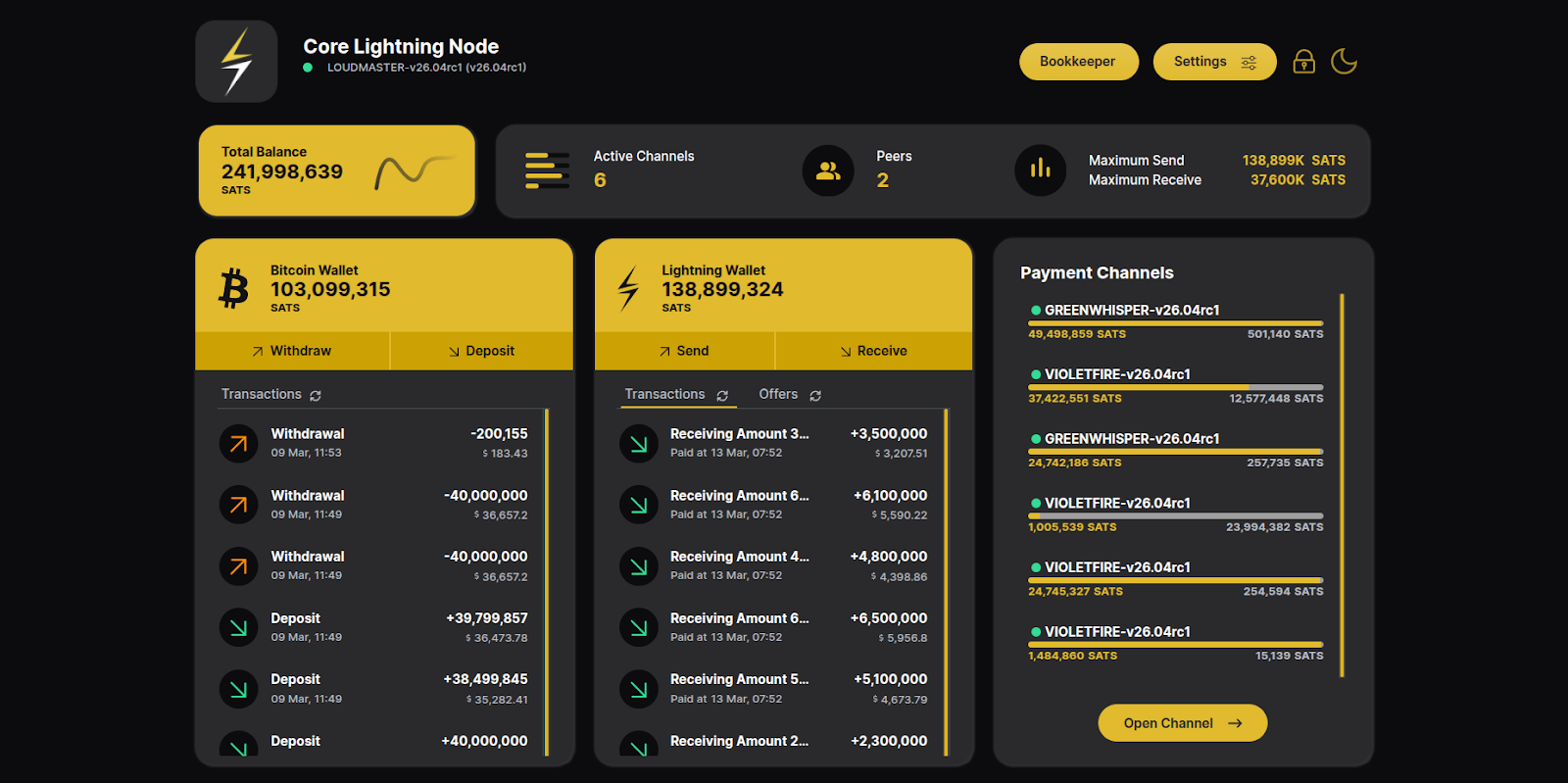
In January, cln-application delivered a series of updates focused on efficiency, usability, and robustness. The v26.01 release included faster initial page load times, and an enhanced user experience introducing features like refreshable list views, improved chart readability, and fiat value tooltips. We also strengthened system resilience by addressing dependency vulnerabilities and improving error handling around fiat rate fetching.
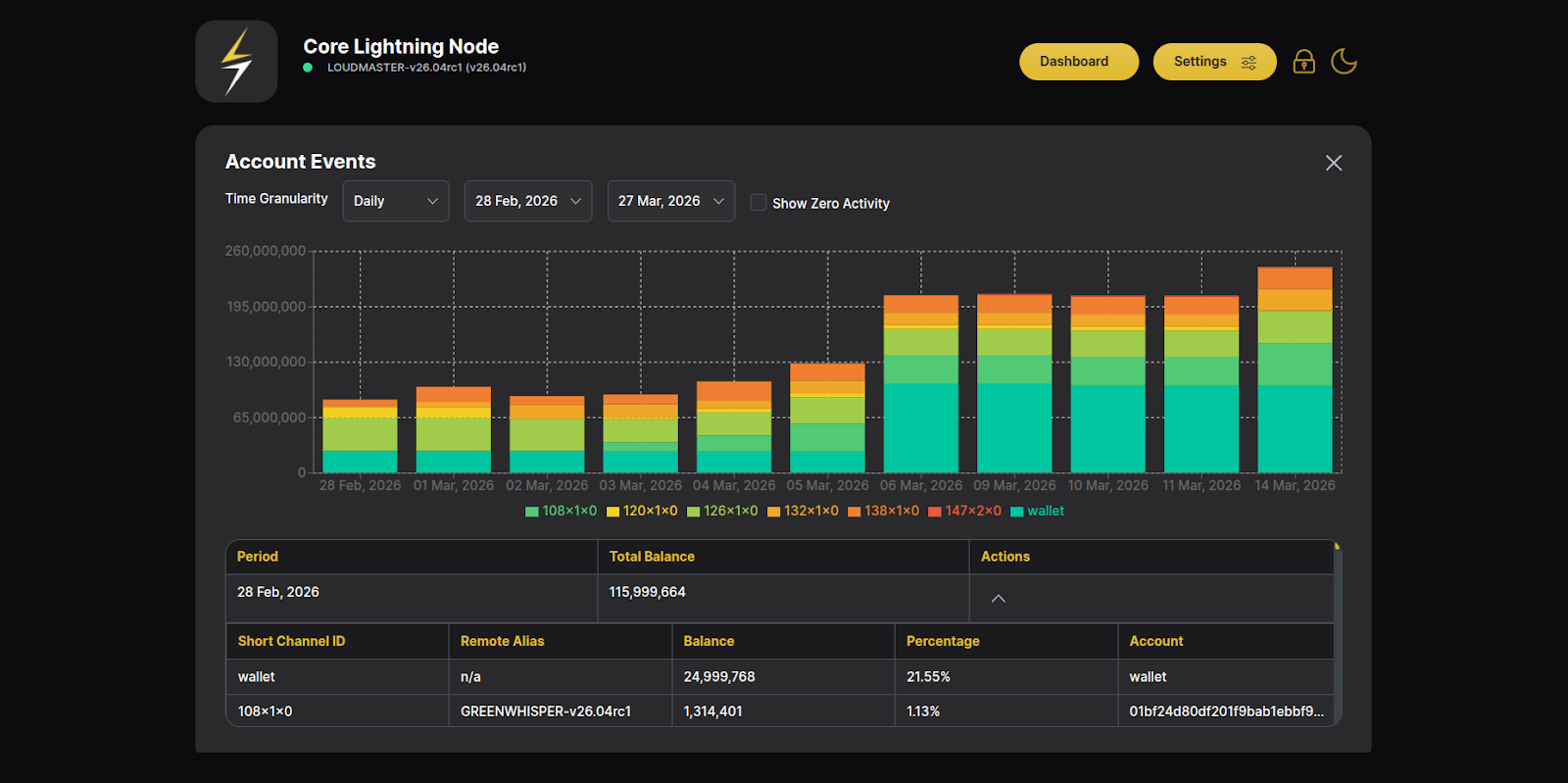
Core Lightning 25.12.1 shipped: a recommended point release, addressing critical fixes especially for nodes created with 25.12. Key fixes included correct signing for non-taproot addresses on new nodes, mnemonic hsm_secret file handling, pay and askrene plugin stability improvements, and improved gossipd and lightningd crash prevention.
On the community front, Lightning Product Manager Michael Blankenship led an interactive Lightning workshop at Plan B El Salvador in late January, exploring what it will take to optimize Lightning for mass adoption.
Media & Event Highlights
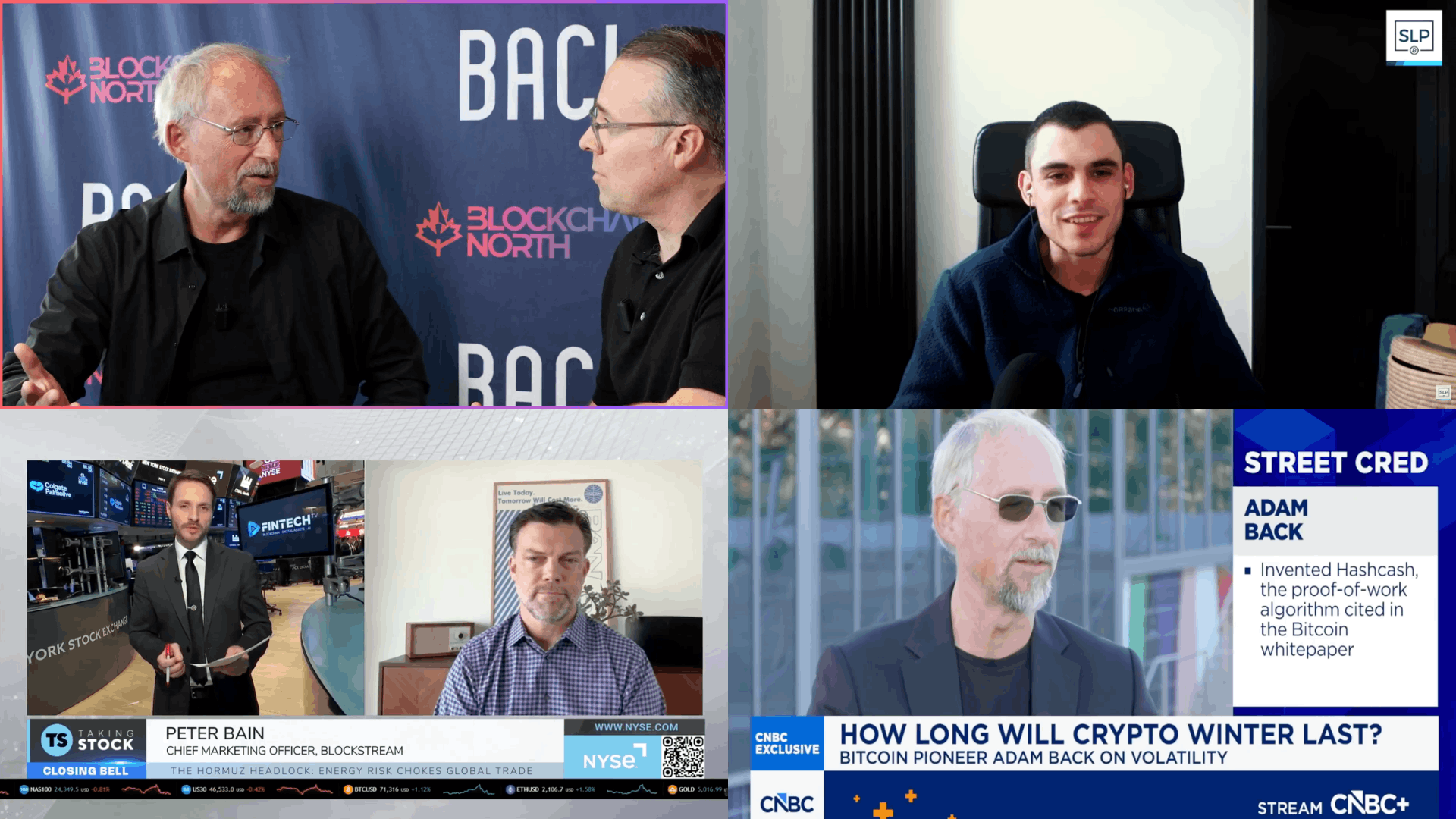
Blockstream stayed active in the media throughout Q1:
- Jonas Nick joined the Stephan Livera Podcast to discuss post-quantum signature research for Bitcoin.
- Jonas Nick joined the TFTC podcast to discuss developing and deploying post-quantum security for Bitcoin.
- CMO Peter Bain sat down with BeInCrypto at the event to discuss accelerating Bitcoin adoption and real-world usage.
- Peter Bain discussed quantum computing and its implications for cryptography on FINTECH TV Global.
- Adam Back appeared on the Plan B El Salvador Podcast from the Mempool Stage, covering Bitcoin's long-term outlook and cypherpunk values.
- Adam Back joined CNBC's Closing Bell Overtime to discuss Bitcoin's downturn, noting that pullbacks are consistent with historical four-year cycles.
- Adam Back sat down with BlockchaiNorth to discuss Bitcoin cycles, institutional adoption, and why this phase could play out differently.
- Adam Back sat down with Tati Topp during the Web3 Banking Symposium to discuss enterprise custody use cases and quantum readiness.
- Adam Back served on the judging panel for the Cyphertank show put on at Plan B El Salvador.
On the community front, the Blockstream Local program continued to expand grassroots Bitcoin education across Q1. Meetup organizers in Gabon, France, and Italy received open-source hardware and self-custody resources to equip their communities with practical Bitcoin knowledge. Blockstream also ran a pay-with-Bitcoin campaign, encouraging users to film themselves paying with the Blockstream app anywhere Bitcoin is accepted, with participants reimbursed for their purchases. Get involved and get paid!
Looking Ahead
Blockstream is in relentless pursuit of new features, products, and capabilities that push us closer to a future of finance that’s built on Bitcoin. Q1 2026 set the tone with Jade Lightning payments and post-quantum signatures on Liquid, two milestones that demonstrate Blockstream's ability to ship robust products and solutions. As Q2 kicks off, here’s what we’re focused on:
- Consumer: Jade Lightning adoption and ecosystem development continues. New Jade product developments are on the way, and continued features for the Blockstream app.
- Enterprise: Expanding Blockstream’s suite of products to serve institutional needs across custody, tokenization, and settlement. Extending Explorer APIs to new audiences and further solidifying Liquid’s institutional position with an upcoming protocol upgrade.
- Research: Extending post-quantum protections to additional Liquid subsystems, refreshing Simplicity documentation to welcome new developer audiences, and targeting Simplicity activation on a Bitcoin testnet.
- Community: Continued Jade distribution to educators and advocacy for greater self-custody adoption.
For more information, visit blockstream.com, reach out to press@blockstream.com, or DM @Blockstream on X.