
In the latest quarterly update, security set the agenda for Blockstream and for much of the Bitcoin industry. We took post-quantum signatures from a Liquid deployment to a draft Bitcoin proposal, shipped security releases across Jade, Core Lightning, and Elements, and worked with the Liquid Federation to recover from the recent security incident. We also rebuilt the Blockstream Explorer, launched 0-conf infrastructure for Liquid, and opened betas for Blockstream Swaps, the Enterprise Custody Solution, and AMP2 for Liquid tokenization.
Major Q3 Milestones
Q3 kicked off with the announcement of Blockstream becoming a founding member of the Bitcoin Security Consortium, whose members pledged $15 million to Bitcoin security research and development over three years. Blockstream researchers co-authored a draft SHRINCS Bitcoin Improvement Proposal (BIP) and showed that today's hardware wallets can already produce post-quantum signatures. As AI-assisted tools sped up vulnerability reports across the industry, our teams shipped fast, public security releases for Jade, Core Lightning, and Elements, including the response to the Liquid Network incident, covered below.
- SHRINCS draft BIP: The first concrete proposal for a post-quantum signature scheme designed for Bitcoin reached the Bitcoin-Dev mailing list.
- Post-quantum signing on hardware wallets: Benchmarks on Jade Plus and wallets from Trezor, Ledger, and BitBox showed every device tested can produce hash-based post-quantum signatures.
- Blockstream Swaps: An in-house swap service for Bitcoin, Liquid, and Lightning opened beta access after a third-party provider paused its service.
- Blockstream Explorer rebuilt: A redesigned explorer for Bitcoin and Liquid that helps you time a send and discover high-value assets on Liquid.
- 0-conf for Liquid: An API that helps swap services and exchanges decide whether to accept a Liquid payment before it confirms.
- Jade firmware 1.0.41: A recommended security update that fixes issues found through AI-assisted scans and human code reviews.
- Simplicity toolchain and signet: The first release of the SimplicityHL standard library, five Simplex software development kit (SDK) releases, and a public Bitcoin signet with Simplicity enabled.
- AMP2 multisig support: Liquid wallets on AMP2 can now be k-of-n or n-of-n, so several keys share control while AMP still co-signs every spend.
Liquid Network Incident Response
The September 6 security incident exposed a vulnerability in Liquid’s codebase, prompting a swift, coordinated response from Blockstream and the Liquid Federation. Within days, the teams deployed a patched version and restored intra-network transactions. The next key milestone was on October 20th: the resumption of BTC<>LBTC swaps through participating providers, without protocol-imposed volume limits, giving users a secure, practical way to transfer bitcoin between the mainchain and Liquid. As of November 2nd, with new security measures implemented and an independent external security audit, we have restored the Liquid peg and 1:1 backing.A detailed account of the incident, its root cause, and initial corrective actions is available in the September 23 security assessment.The incident accelerated an effort already underway to strengthen Liquid’s security infrastructure and operational resilience. These improvements span independent security audits, enhanced consensus-code testing, stronger peg-out safeguards, and additional operational controls, laying the foundation for a more secure and resilient network.
The Liquid Federation Board was also unified throughout the process. Since restoration of the network, we have focused our attention on new governance policies to address emerging threat models that new technologies introduce.
0-Conf Goes Live
In July, Blockstream delivered another milestone from the Liquid development roadmap with the public release of its 0-conf infrastructure for Elements and Liquid.While Liquid transactions achieve settlement finality after two confirmations, or approximately two minutes, payment providers, exchanges, and swap services often require faster processing. The new 0-conf service addresses this need by providing standardized, real-time visibility into transaction propagation across the network. This allows integrators to assess whether to accept transactions before confirmation, without building and maintaining their own Federation monitoring infrastructure.Developed and tested with Liquid Federation members through multiple beta phases, the service is now publicly available through REST and WebSocket interfaces. Although 0-conf does not guarantee settlement, it provides a valuable additional signal for reducing payment latency and improving the user experience.Technical documentation is available here.
Blockstream Research: Post-Quantum Bitcoin Moves Forward
A large enough quantum computer could one day break the signatures that protect bitcoin today, and moving Bitcoin to new cryptography would take years. In Q3, Blockstream Research took that work from a proposal to a draft BIP and tested post-quantum signing on real hardware wallets.
SHRINCS Reaches the BIP Process
On August 26, the SHRINCS Working Group posted the first draft SHRINCS BIP to the Bitcoin-Dev mailing list. It turns the proposal from Director of Research Jonas Nick and cryptographer Mikhail Kudinov into a specification with a reference implementation that Bitcoin developers can review and test. Bitcoin Optech Newsletter #421 covered the draft.
Today, we're publishing BIP SHRINCS, the first concrete proposal for a post-quantum signature scheme designed specifically for Bitcoin.
— Jonas Nick (@n1ckler) August 26, 2026
The BIP draft turns what began as a rough idea into exact algorithms with an executable reference implementation.
This is an important… pic.twitter.com/7xGri2ggtP
In Searching for SHRINCS Parameters, the team tested 25,935 parameter sets and found signature options about 25% smaller than SLH-DSA with a reduced signature budget, which means less block space and 28% cheaper verification for every node. The parameter explorer is open source, so anyone can check the choices. Jonas Nick and remix7531, an OpenSats-funded formal verification researcher, then published libshrincs, a proof-of-concept C implementation of the one-time signature inside SHRINCS that comes with machine-checked proofs of correctness and security, a layer of assurance beyond code review and testing.
Post-Quantum Signatures on Today's Hardware Wallets
In August, Blockstream Research showed that the hardware wallets people already own can produce post-quantum signatures, answering a common concern that they could not. The team benchmarked five hash-based signature schemes on Jade Plus, Trezor Safe 3, 5, and 7, two Ledger devices, and BitBox02 Nova. A compact 324-byte signature from an earlier SHRINCS design took about 22 to 42 seconds to sign, with Jade Plus fastest at 21.75 seconds. We thank the Ledger, SatoshiLabs, and BitBox teams for their help!
Evaluating Lattice-Based Signatures
The team also published Falcon, Dilithium, and the Fall of Hawk, a report on whether lattice-based signatures could make post-quantum Bitcoin cheaper than hash-based schemes alone. It names Falcon-1024 as the strongest candidate: once NIST finalizes its standard, Falcon could replace the SHRINCS backup signature with one that is far smaller and faster for every node to verify.
More From Research
- libsecp256k1 v0.8.0: The cryptography library released v0.8.0, integrating support for Silent Payments (BIP 352).
- ChillDKG draft BIP: The team submitted a pull request to the BIPs repository for ChillDKG, the distributed key generation protocol designed for the FROST threshold signature scheme. ChillDKG allows signers to generate shared threshold keys securely without a trusted third party.
- DahLIAS draft BIP: Fabian Jahr wrote a draft BIP to standardize DahLIAS, a scheme from Blockstream Research's Jonas Nick and Tim Ruffing with Yannick Seurin that folds many signatures into one 64-byte signature and saves block space.
- Signature standards review: Within 48 hours of publication, Mikhail Kudinov found two critical design flaws in FlexTree, a hash-based candidate in Round 1 of China's Next Generation Commercial Cryptographic algorithms program.
- SLH-DSA proof gap: Jonas Nick showed that the security proof NIST's SLH-DSA standard cites misses more than 2^68 hash computations for its 128-bit parameter sets. The finding does not amount to an attack on SLH-DSA.
Simplicity: A Complete Developer Toolchain
In July, the redesigned simplicity-lang.org launched with pages on capital markets and applications such as lending, escrow, inheritance, and post-quantum wallets. Building on Simplicity followed on July 30. By the end of the quarter, developers could use:
- One-click environment: A devcontainer, runnable as a GitHub Codespace, bundles tooling including the SimplicityHL compiler, SDK, contract examples, and a language server.
- SimplicityHL 0.7 and 0.8: Clearer compiler errors, a move to MIT or Apache-2.0 licensing, and an update to the latest Simplicity and Elements libraries.
- Standard library: simplicityhl-std, the SimplicityHL standard library, shipped its first release with checked integer arithmetic, boolean logic, and secp256k1 point operations.
- Simplex SDK: Releases of Simplex added WebAssembly bindings to let web apps understand and drive Simplicity contracts, smarter integration tests, and standard library package support.
- Humid wallet: Humid, an experimental, Simplicity-first browser extension wallet for Liquid, was launched to let developers iterate on smart contract functionality against a realistic wallet.
- Txmanifest: A file format for describing Simplicity contracts and the on-chain transactions they accept saw continued development and wallet integrations (including Humid). This allows an ecosystem of many wallets and many smart contracts to interoperate without custom code.
- Lending contract: The Lending v2 contract is finalized: a demo of Simplicity for real financial applications and the basis for lending products.
The first Simplicity capture-the-flag challenge ran in July, and weekly Office Hours carried live demos from ecosystem teams, including Resolvr's Apogee wallet. Next on the list are a fuzz-testing framework, a Wallet ABI specification, deeper Liquid Wallet Kit (LWK) and Jade integration, and a contract registry for human-readable signing.
In August, Blockstream engineers Kyrylo Riabov and Artem Chystiakov posted DAMP to the Simplicity community forum. The proposed design would let issuers of regulated Liquid assets enforce their rules on-chain, so holders could transfer without the issuer signing off on each move.
On September 30, we started a Bitcoin signet with Simplicity enabled, open to anyone at signet.simplicity-lang.org.
Jade: Stronger Firmware and UPS Pickup
The hardware wallet industry experienced trial by fire in Q3. We published steps for anyone who needed to move funds, and offered 15% off, free expedited shipping on Jade, and Blockstream Local expedited shipments to meetup organizers. To double down on the safety of our users, US and Canadian customers can now pick up Jade orders at UPS Access Points, such as UPS Stores and, in the US, CVS locations.
Your bitcoin is only as safe as the randomness your keys are made from.
— Blockstream Jade (@BlockstreamJade) August 5, 2026
Jade blends 9 independent sources of randomness, from a dedicated hardware chip to camera noise, into a result that exists only once.
Our code is open-source, so anyone can verify it. pic.twitter.com/zaOpQABCLb
To further show how Jade protects a PIN without a secure element, we explained Jade's virtual secure element.
Jade firmware 1.0.41 shipped in August with fixes for issues reported through dozens of AI-assisted scans and human reviews of the Jade code, and the Jade firmware developers recommend upgrading as soon as you safely can. The team added triage staffing to keep pace with the reports, and firmware 1.0.42, with fixes for less serious ones, is on a shorter development timeline.
A huge thank you is warranted to the community for their contributions, call outs, and feedback for Jade improvements, and to our excellent team of engineers, who have been working around the clock to ensure Jade’s resilience during these times of unprecedented cybersecurity attacks.
Blockstream App: Swaps, Lightning on Desktop, and Safer Signing
On August 3, Boltz paused its swap services, which took down in-app swaps for the Blockstream app and other wallets. A week later, we announced Blockstream Swaps, an in-house service for submarine, reverse submarine, and BTC to LBTC chain swaps. It lets you pay Lightning invoices from BTC or LBTC without managing channels, including from cold storage, and runs alongside existing providers for redundancy. Blockstream Swaps is in beta with select participants, and in September we invited more users to request access.
Announcing Blockstream Swaps.
— Blockstream (@Blockstream) August 10, 2026
Trustless atomic swaps for Bitcoin, Liquid, and Lightning. Hold BTC or LBTC and pay Lightning invoices without managing channels or inbound liquidity. Reach Lightning from cold storage while keeping full control of your funds.
Built as a…
Blockstream app 3.5.0 for desktop added Lightning send and receive in beta. Jade QR Mode and air-gapped signing for descriptor watch-only wallets give the desktop app a fully air-gapped path from setup to spend, so your keys never touch an internet-connected machine. The app also mixes randomness from your computer into Jade's own at setup and unlock, so tampering with it would mean compromising both devices. In September, version 3.6.0 added payments to Lightning addresses and LNURL-pay requests and restored 2-of-2 and 2-of-3 multisig account creation.
On mobile, version 5.6.0 added manual coin selection for BTC and LBTC sends and recovery actions for stuck swaps on Android, AMP2 accounts on testnet, and a new receive flow on iOS. The iOS app now requires Anti-Exfil signing on compatible Jade firmware, which stops a compromised device from leaking your keys through its signatures, and refuses LNURL-pay invoices whose amount differs from the one you requested. In late September, version 5.7.0 for Android and iOS added a Bitcoin price chart, coin selection, and Liquid asset details on Jade when signing, and restored 2-of-2 and 2-of-3 multisig account creation.
- Download the Blockstream app for iOS, Android, or desktop.
Blockstream Explorer: Rebuilt for Bitcoin and Liquid
In August, we launched a rebuilt Blockstream Explorer at blockstream.info for Bitcoin, Liquid, and both testnets. A live view of the next block shows where your fee would land, so you can time a send, and transaction pages flag privacy leaks such as address reuse and estimate when a transaction will confirm. For Liquid. For Liquid, you can discover high-value assets on the network, and Simplicity spends are fully decoded. The redesign is open source as Esplora v3.0.0.
The Blockstream Explorer API gained a documented block-template endpoint, so mining tools can pull a block template alongside the chain data the API already serves. Liquid Wallet Kit 0.19 added descriptor subscriptions that tell wallets when to rescan. Both LWK and BDK now have built-in support for authentication so you can connect to the Enterprise Explorer API seamlessly and use REST, Electrum and QuickSync.
We have also launched support for Bitcoin Testnet4 to progressively become the default Bitcoin Testnet. This change is aimed at addressing known Testnet3 limitations which include block storms (thousands of blocks can arrive in minutes), timewarp attacks, scarcity of test coins, and problems to sync the chain.
- Get started with Blockstream Explorer API.
- Reach out for enterprise inquiries.
Lightning: Security Releases
Core Lightning spent Q3 working through a surge of AI-assisted vulnerability reports. In July, v26.06.6 shipped as a maintenance release. On August 28, Core Lightning 26.06.7 fixed several responsibly disclosed vulnerabilities. The project published signed binaries first and held back the source for 14 days, so operators could upgrade before the fixes were public. Operators who could not upgrade right away could restart their nodes with the --offline flag if not able to update immediately. In September, the team advised operators to turn off experimental features, and v26.06.8 followed with further fixes.
On September 29, we published cln-application v26.09, the maintenance release. The work focused on making the app safer and easier to run with stronger login and password protection, support for secure connections, and a more robust build and release process. Everyday use is unchanged, with a few small fixes to how balances display and how the app behaves alongside other node applications.
Blockstream Enterprise
Blockstream Enterprise opened its beta to a select group of private clients, allowing them to experience our custody and tokenization stack, which enables digital asset management for banks, prime brokers, and Bitcoin-native firms that adheres to essential standards. The entire architecture operates on a novel security model that we’ll be unveiling at the Digital Asset Forum in New York City on November 13th.
There’s still time to request a seat for the forum! Fill out this form.
Learn more about Blockstream Enterprise.
Media & Events
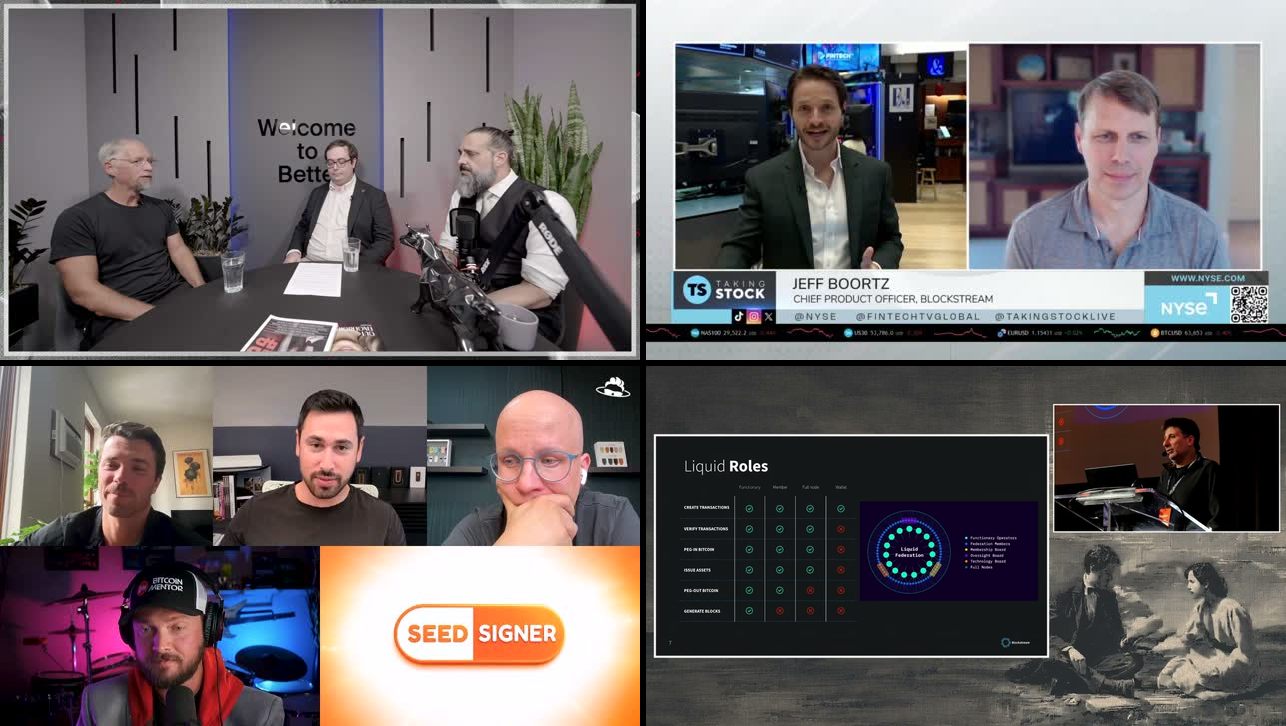
- Adam Back, CEO, sat down with Bitcoin Suisse on the quantum timeline for Bitcoin and the case for SHRINCS.
- Pablo Greco, Director of Engineering, explained how Liquid reaches consensus on new blocks at bitcoin++ Toronto.
- Russell O'Connor presented a machine-checked proof that libsecp256k1's modular inverse is correct at bitcoin++ Toronto.
- Drew Fischer, from the Jade team, joined a BTC Sessions panel with Foundation, Trezor, and SeedSigner on hardware wallet security after the Coldcard disclosure.
- Rich Grambergs, from the Jade product team, joined the Stephan Livera Podcast on Jade's dice entropy, the blind oracle, multisig recovery, and the Swaps beta.
- Jeff Boortz, Chief Product Officer, joined J.D. Durkin on FINTECH.TV's Taking Stock to explain what Coldcard owners should do next.
As a partner of the Learning Bitcoin Foundation, Jade gave every attendee of its August 22 event in Vancouver a free device. We teamed up with the Bitcoin Ed Foundation to supply hardware wallets for a Bitcoin class at Columbia University, where every student generated their own recovery phrase. We also donated Jades to a veterans session at Georgia's VECTR center, and Blockstream Local continues to equip meetup organizers with open-source hardware.
Looking Ahead
The work Q3 started carries into Q4:
- Research: Taking the SHRINCS BIP through community review.
- Consumer: Running the Blockstream Swaps beta and the desktop Lightning beta.
- Developers: Simplicity fuzz testing, the Wallet ABI specification, and the next Core Lightning release.
- Security: Ongoing AI-assisted scanning, red-team testing, and Jade firmware updates.
- Liquid: Continuing the modernization efforts of the Federation’s governance model.
- Enterprise: Shipping MPC (to be revealed at DAF in NYC), and developing fully air-gapped signing solutions.
For more information, visit blockstream.com, reach out to press@blockstream.com, or DM @Blockstream on X.